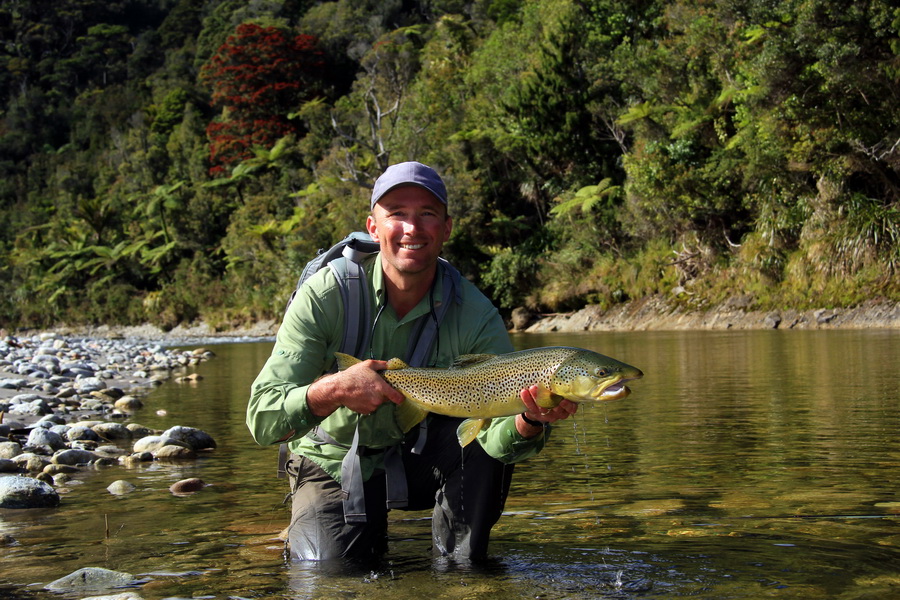
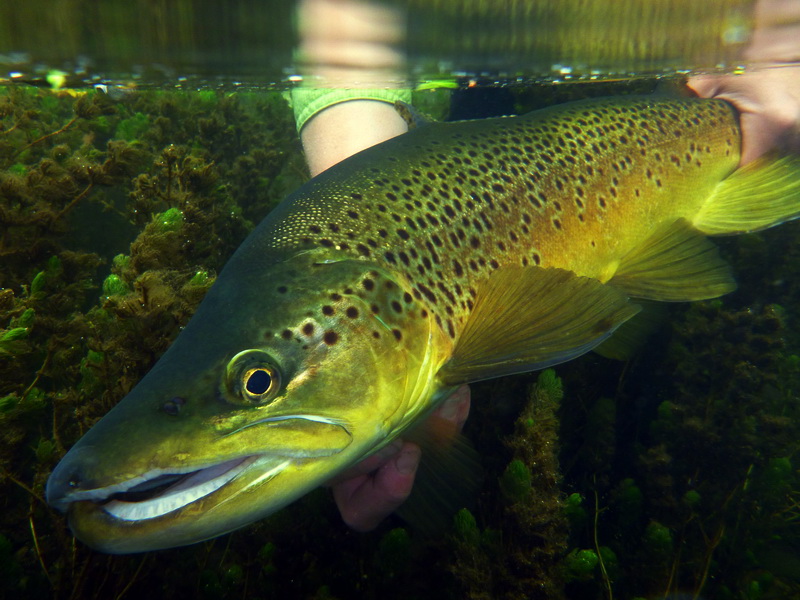
This, to keep the spirits of fly fishers back home. This is long, lots of pictures. Sorry, but figured some might need a distraction from the snow. How's the following for 10 days of fishing?
As always - click the pic to see the bigger version.
Well, we arrived in New Zealand on the tail end of a heavy rain that left a remarkable strip of ravaged trees and vegetation - some 40 feet above the Grey R. Impressive amounts of water. The levels were generally down everywhere when we arrived, though the last of the higher water still had some great fish in the smaller tributaries. We capitalized on several days worth of good fishing in some of our favorite waters and enjoyed time with our friend Sharron. We moved on to try to head SW to find some more penguins - we have yet to see the Fiordland crested. However, as fates had it, we got detoured to fishing some spring creeks. We never stopped! At first, we fished a few reaches of waters we'd done before. Clearly, the high water of last Christmas period that we were here for had effects on a few reaches as gravel shifted and filled in old, reliable runs. In one case, one reach had only 4 trout with little chance of hiding fish for how shallow it has become. They weren't difficult to catch as they likely haven't seen anglers in some time. Other reaches were very good to us once again. Last year we popped in to one short spring creek to find a mix of rainbows and browns - this visit there were only browns. However, we tagged into some fish in the 6 to 7.5 lb range - impressive for a creek less than 5 yards wide. 


After that experience, we drove to another mission impossible creek. Last year we fished it twice and had no success. It's essentially a ditch with trout 6 to 14 lbs in gin clear water. Trout don't mind herds of cattle beside them but wave a fly rod 15 yards in any direction and they bolt. This year was different. AJ hooked up a couple of nice fish and I missed a couple of dandies on what were thought to be good hook sets. A the very end of that short run we came upon the 100m of death. Big fish in clear water that move about in searching feeding and spook at first sight. They seldom position and if you are within casting reach for 2 rises in succession, that was your opportunity as the next rise would be at its next station 30 or 40 feet away. It's amazing to watch their wakes move about this water. We arrived at dusk and I could make out a dark torpedo in a trough upstream. It wasn't doing much and I was able to get a good couple of casts over it. Third cast my dry went down and I was hooked up. Bravo! But how do you get a tank out of heavy weeds? Pull hard and lift up - either yard its head up or it's over. And that's what we did. As the fish came to the net a 10+lb trout swam within 2 feet of my net to see what was wrong with mine. Thought of netting it for a brief second but having 17 lbs of brown in the net, thrashing, likely wasn't a good plan. :)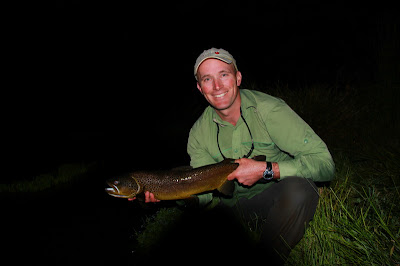


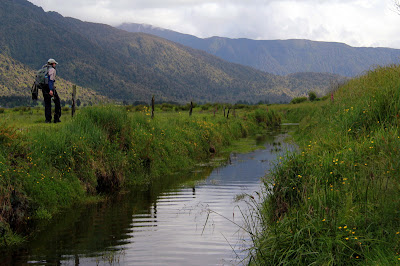


The next day we headed to fish a new stream nearby. We hadn't heard anyone ever talk of it and when we stopped in to talk to the farmer, he told us that some used to fish it regularly years ago, but it was a small troupe of anglers and it hadn't seen much action in recent years. And I think it was the coldest day of the winter back home. :) You know how that day went!
Along the way, we decided to target a few other un named springs that are short lived tribs to streams. Farm fields that drain springs into ditches, to small streams, to creeks, to main rivers. To see large trout in such water is amazing. To watch one come to a #6 red damsel nymph as you dap-swim it in pulses, watching the fish miss on the first two pulses but hammer the third, taking literally below your feet is astounding. Trying to land an 8 lb fish in such weed choked water is incredible.
And then there was the other day we decided to walk the NZR a distance - about 6 km to pick up a stream mouth and walk it back up. Again, when told by a land owner "nobody ever goes back there" your ears perk up. And the fishing once more went as you'd expect. Not huge fish that day but amazing optics of dry fly takes. And we shouldn't forget the 4 hours we spent at the end of another day. We stopped in to see if we could walk the bottom end of a drainage ditch. It was straight as an arrow but on Google Earth shows as a winding creek for 300 yards before it drains into a side channel of a small river. We walked down and got intrigued by the river side channel - landing 4 nice trout. As we made our back up to the mouth of the ditch, we noted a 3 foot wide, 6" deep spring coming from the left. We followed it up and spotted 6 trout (3 to 6 lbs) in shallow riffles, hooking a few. We got back to the original plan - to the short reach of the lower ditch reach and came upon 7 trout in the 3 to 7.5 pound range. The large fish was hooked but the video shows the line pulling the head up and the mouth opening wide and after 4 or 5 open-jawed thrashes the hook popped. Bugger - especially after the time it took to get into position. We then came upon a 'run' (10 yards long and 3 wide) with 3 trout 4 to 5.5 lbs, taking each. To cap the day Amelia got the take but missed setting on an 8 foot dap-bow & arrow cast and I landed a 3.5 lb fish from the pool at the end of the 3km straight, shallow ditch. The fish was rising and upon hooking, lept out of the water onto the gravel - I yarded as hard as I could to drag him into water. Still on, I was able to smile for one more photo. :)
To date, we have not fished water greater that 10 yards wide this trip and have likely caught a dozen 7 lb fish. Amazing. Of course, in some instances, the 2 to 4 lb fish that came out of 2 yard (or less) wide creeks steal the show for how surprising they are. It comes down to the experience of the fishing moment far more than the size. I've wallowed on my stomach in mud far more times this trip than my life combined. Tomorrow brings about a week of rain. Not sure where we're headed but we know that the fishing will slow - simply due to the poorer spotting conditions in rain and wind, plus the sheer volume of water in the rivers. It should still be ok for much of the week, but blue and purple on radar is coming. I'm sure nobody will feel sorry for us if we get swamped. It has been the most amazing year of fly fishing and we're still 2 days shy of the first 2 weeks of 3 months. The coming rains are a blessing - we couldn't maintain this pace that long!